
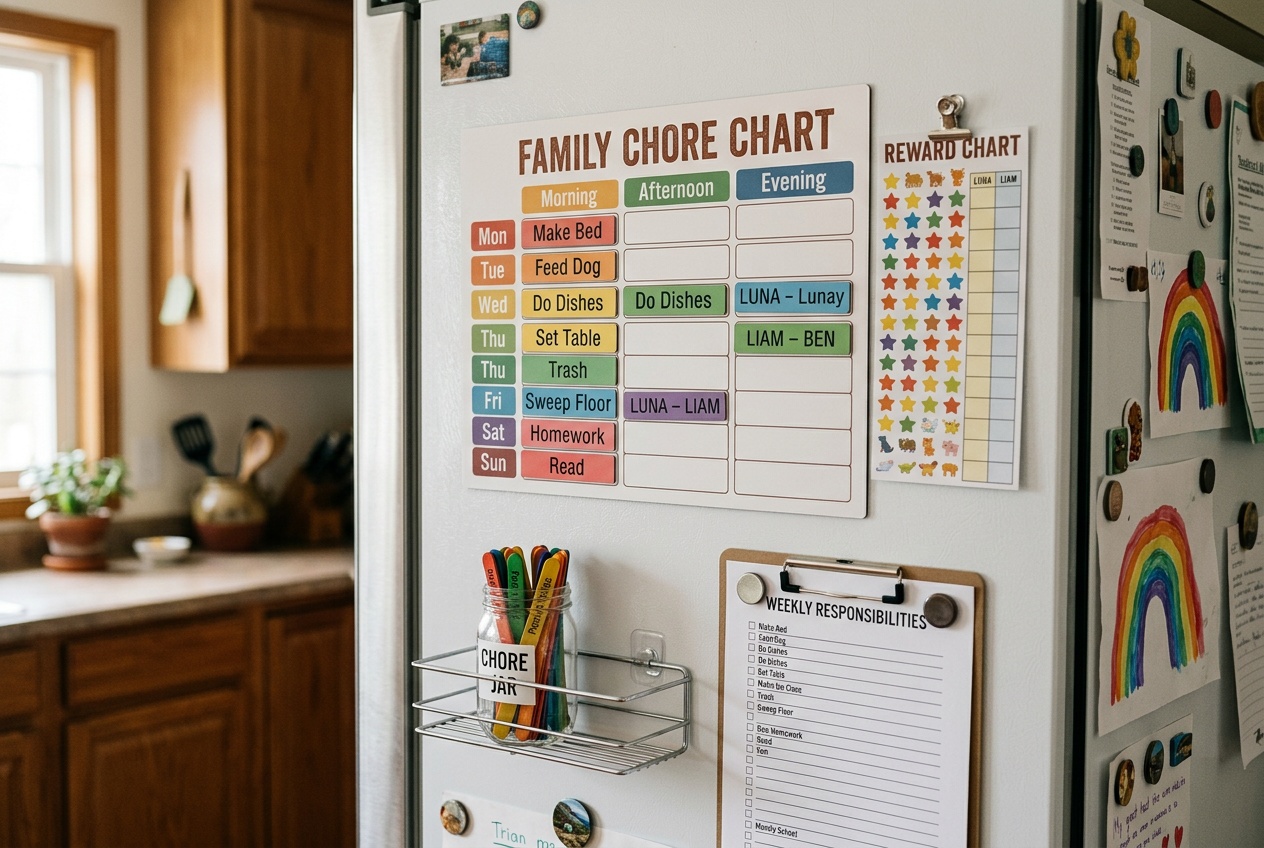
Getting kids to help around the house can be a challenge. A chore chart system makes it easier by giving children clear tasks and tracking their progress.
The right chore chart helps kids build responsibility and creates less stress for parents. Different families need different approaches based on their children’s ages and what works in their daily routines.
I’ll walk you through various chore chart options that range from simple sticker systems for young children to digital apps for older kids. You’ll learn about magnetic boards, token systems, and other methods that keep households running smoothly.
1) Magnetic dry-erase chore chart with movable magnets
I find magnetic dry-erase chore charts to be one of the most flexible options for families. These charts hang on your refrigerator or any metal surface, making them easy to access in high-traffic areas of your home.
The system uses small magnets that kids can move from one column to another as they complete tasks. I like this approach because children get immediate satisfaction from physically moving their magnet to the “done” section.
Most magnetic charts come with a dry-erase surface where I can write chores that change week to week. This means I’m not stuck with pre-printed tasks that might not fit my family’s needs.
The movable magnets often have different colors or names on them so each child can track their own progress. Some versions include star magnets or reward markers that I can add when kids finish all their tasks.
Cleanup is simple since I just wipe the board clean and rewrite new chores as needed. The magnets stay in place without falling off, which prevents arguments about whether someone actually completed their work.
2) Sticker-based reward chart for preschoolers
I find that sticker charts work well for young children between ages 3 and 5. At this age, kids respond to visual rewards they can see and touch.
The setup is simple. I create a chart with rows for each chore and columns for days of the week. When my preschooler completes a task, they get to place a sticker in the matching box.
The physical act of putting the sticker on the chart makes the reward feel real to them. I use bright, colorful stickers with their favorite characters or shapes.
I keep the chore list short for this age group. Three to five simple tasks work best, like putting toys away, brushing teeth, or feeding a pet.
I place the chart at my child’s eye level so they can reach it easily. This helps them feel involved in tracking their own progress.
After they earn a set number of stickers, I give them a small reward. This might be extra playtime, a special snack, or picking the family movie. The reward doesn’t need to be expensive or elaborate.
3) Chore jar system with labeled task popsicle sticks
I like the chore jar system because it adds an element of surprise to daily tasks. You write different chores on popsicle sticks and place them in a jar. Each child picks a stick and completes that task.
This system works well for families who want to rotate chores regularly. Kids don’t do the same job every day, which keeps things interesting.
To set it up, I get a jar and popsicle sticks from any craft store. I write one chore on each stick using a permanent marker. The chores should match your child’s age and ability.
You can use different colored sticks for different difficulty levels. For example, green sticks might be easy tasks like feeding pets, while blue sticks could be harder jobs like vacuuming.
I recommend having each child pick one or two sticks per day. Once they finish a chore, the stick goes back in the jar for another day.
This system teaches kids flexibility since they can’t predict which chore they’ll get. It also feels more fair because everyone takes turns with the less popular tasks.
4) Printable weekly chore checklist for elementary kids
I find that printable weekly checklists work well for elementary-aged children because they can see their tasks laid out clearly. These charts usually cover Monday through Sunday with simple chores listed for each day.
Most printable checklists include basic tasks like making the bed, putting away toys, and feeding pets. Some also have spaces for kids to check off completed chores or add stickers.
I recommend choosing a chart with large, easy-to-read boxes. Elementary kids need visual clarity to stay organized.
You can find free printable templates online or make your own. I suggest laminating the chart so kids can use dry-erase markers to check off tasks each week. This makes the chart reusable and saves paper.
Hang the checklist in a spot your child sees often, like on the refrigerator or their bedroom door. I’ve noticed that visible reminders help kids remember their responsibilities without constant prompting.
The best printable checklists keep things simple. They focus on 3-5 age-appropriate chores per day rather than overwhelming kids with too many tasks.
5) App-based chore tracker: OurHome
I’ve found that OurHome is a digital chore management app that works well for families. The app lets me assign tasks to each family member and track their progress from my phone.
Each child gets their own profile in the app. I can create custom chore lists for different age groups and set up recurring tasks that repeat daily or weekly.
The app includes a points system that rewards kids when they complete their chores. I can decide how many points each task is worth based on difficulty. Kids can see their point totals go up as they finish more chores.
OurHome also has a grocery list feature and a family calendar. This means I can manage multiple household tasks in one place instead of using several different apps.
The app is free to download with basic features. There’s a premium version available if I want access to more advanced options. It works on both iPhone and Android devices, which makes it easy for my whole family to use.
6) Star chart with laminated cards and velcro
I love this system because it’s durable and reusable. You laminate cards with each child’s chores and attach velcro dots to the back.
The chart itself has matching velcro spots where kids can stick their completed task cards. When they finish a chore, they move the card to the “done” section.
Laminated materials hold up well against spills and rough handling. I’ve found that velcro makes it easy for even young kids to move their cards around without help.
You can create different colored cards for morning tasks, after-school chores, and weekend jobs. This helps kids see what they need to do at different times.
The best part is that you can wipe the laminated cards clean and reuse them for years. You can also swap out chores as your kids get older without making a whole new chart.
I recommend using heavy laminating pouches so the cards don’t bend or tear easily. Strong velcro dots work better than the weak adhesive ones that fall off after a few weeks.
7) Point-based allowance system with spreadsheet tracking
I use a digital spreadsheet to track points my kids earn from their chores. Each task has a specific point value based on how hard it is and how long it takes.
Simple jobs like making beds earn 5 points. Harder tasks like washing dishes earn 15 points. I set the point values at the start so everyone knows what to expect.
At the end of each week, I add up the points in the spreadsheet. My kids can see their totals anytime since I share the document with them. This helps them stay motivated throughout the week.
I convert points to money using a simple rate. For example, every 10 points equals one dollar. My kids can cash out their points for allowance or save them for bigger rewards later.
The spreadsheet keeps a running history of all their work. I can see patterns over time and adjust the system if needed. My kids also learn basic money skills by watching their earnings grow.
8) Visual morning/evening routine board with pictures
I recommend using picture-based routine boards for younger children who can’t read yet. These boards show each task as a simple image or icon. Kids can look at the pictures and know exactly what to do next.
You can make one by printing photos of your child doing each task. Brush teeth, get dressed, pack backpack, and eat breakfast are common morning tasks. For evening routines, I suggest including pictures for bath time, pajamas, and bedtime stories.
Attach the pictures to a poster board in order from first to last. Some parents use velcro or magnets so kids can move each picture to a “done” section. This gives children a sense of accomplishment as they complete each step.
I find that visual boards work best for kids ages 2 to 6. The pictures remove the need for reading skills. They also help children remember what comes next without asking a parent every few minutes.
You can buy pre-made visual routine cards online or create your own. Taking photos of your own child makes the board more personal and engaging for them.
9) Token economy board with exchange menu
I recommend using a token economy board if you want to teach your kids about earning and spending. This system works by giving children tokens when they complete their chores. The tokens can be plastic coins, poker chips, or even stickers.
The key part is the exchange menu. This is a list that shows how many tokens each reward costs. For example, 30 minutes of screen time might cost 5 tokens, while choosing dinner could cost 10 tokens.
I set up a visible board where kids can see their token count. They learn to save tokens for bigger rewards or spend them right away on smaller ones.
The exchange menu should include different types of rewards at various price points. Mix in privileges like staying up late, small toys, or special activities with a parent.
I find this system works well because it mirrors real-world money management. Kids practice making choices about saving versus spending. They also see a direct connection between their work and what they can earn.
10) Family bulletin board with rotating responsibility cards
I recommend setting up a central bulletin board where everyone in the family can see their current chores. This system uses individual cards that you can move around as tasks change.
You’ll need a corkboard or magnetic board mounted in a common area like the kitchen. Create cards for each chore with clear descriptions of what needs to be done.
Each family member gets a column or section on the board. I place their responsibility cards in their assigned space at the start of each week.
The rotating part means you switch who does which chore on a regular schedule. Some families rotate weekly, while others change every two weeks or monthly.
This system works well because kids can physically see what they need to do. They can remove cards as they complete tasks, which gives them a sense of accomplishment.
You can color-code the cards by task type or family member. I find that using different colors makes the board easier to read at a glance.